Home of Shiva
A WORLD HERITAGE MONUMENT
Drone Mitra
- About Me
- Lohagad Lonavala Maharashtra Blog about the VLOG
- Parnera Hillocks Atul Valsad
- Veera’s Banquet
- Veeras Restaurant & Dhaba Catering & Banquet
- VLOG Daman Fort Drone Video Full – Drone Mitra
- तड़केश्वर महादेव
It is amazing how Indian culture is available to us in an unbroken thread through the labyrinth of history as well as several dark centuries whose records show innumerable blank pages.
This is because our culture has been conveyed through interesting legends and stories which have a spread to all four corners, unsullied by time and unchanged by the environment.
However, our culture that goes back 5000 years has not come to use merely through literary sources.
The most permanent source has been the transfer of our culture through monuments, their sculptures and paintings. They were brought down to us through the legends of ancient India with strength, sensitivity and grace. Whether the medium used was wood, stone, or paint, our artists and artisans have paid homage to our great culture and kept intact these immortal myths and legends of India.
INTRODUCTION
Western India abounds in caves temples, the earliest of which were excavated about the beginning of the Christian era. These were, in the earlier stages, almost exclusively Buddist in character. With the decline of Buddhism, this particular form of architectural activity was continued by the Hindus, who carried it to its culmination in the great Saivite cave temples of Elephanta and Ellora. Sculptures from the former Idar State that have recently come to light tend to indicate connections with Western Gupta art, so that Hirananda Sastri’s belief that they may have been excavated by the Mauryas of the Konkan gains additional credence. These rulers also held Mewar and the surrounding districts in the 8th century A. D., and earlier still were defeated by Pulakesin II about 635 A. D. after a great naval battle which may have taken place off Elephanta. Pulakesin was a fine warriour, responsible for checking the entry of Harsha who was the most powerful king of Northern India into the Deccan and the South. He also fought the Pallava Mahedravarman !, “Tiger among artists”, whom he besieged in his capital city of Kanchipuram. The age of these three kings also witnessed great artistic activity in the country, for the important Pallava style was about this time; the Chalukyas matched their achivement in war with fine temples excavated and built in their home country at Badami and Aihole, while Harsha was equally bountiful in his patronage of artistic and cultural activities in Northern India. The stylistic evidence of the sculpture too, free as it os from Southern influences, and in the delineation of mountains, clouds, costume and jewellery of the figures, indicates a close proximity to the traditions of the Gupta age, so that one would not be far off the mark if the caves were dated to a period between c. 600-635 A. D. Be that as it may, the high quality of the sculptures at Elephanta are not to be denied. The voluptous heaviness of the early forms of Deccan cave sculpture, especially as seen in the mithuna figures at Karla, is here impressed with the balance and grace of the gupta idiom. The power and life of the earlier sculpture is still present, but it is dignified and restrained into a vision of fresh beauty. The cave temples on the island are dedicated to Shiva, and another testimony to the renaissance of Saivism at this period. The Siva myths had been already formulated and episodes from His life had been fine poetry by Kalidasa. Siva was conceived as the Supreme Diety, as both the Creator and the Destroyer of the Universe. As a Creator he was worshipped in the form of linga, and His aspect as the Destroyer is apparent in His terrific forms, especially that of Bhairava, Devotion of Him was also a sure path to salvation, and the beneficient aspects of the God gained prominence, so that the sculptor of Elephanta could take great joy in depicting a scene of domestic bliss on Kailasa. In the great Maheshmurti at Elephanta, all these aspents of Siva- that of Creation, Preservation and Destruction – are combined.
Details
TOURIST GUIDE TO ELEPHANTA CAVES
Elephanta island is situated about 11 kms. northwest of Apollo Bunder near Gateway of India, the southern most end of Mumbai. Departure point for ferries to the famous caves can be found here. Elephanta is about 1050 hectares during high tide. It is a range of trap two and a half kilometers in length and about 173 meters above sea level. The island, which has a coast line of 7 kms, consists of two hillocks seperated by a narrow valley and once full of mangroves, but now on the decline. The rocky out crop found on the island is made up of trap, a form of basalt. There are three small villages namely Raj Bunder, Shet Bunder and Mora Bunder located over the island and still inhibated by people, population roughly being 1600. Farming and fishing is the main occupation of the habitant people here. Elephanta Caves is also one of the source of income for them. This island was known as “Gharapuri” in the ancient literature. The first component denotes the Gharis that is the sudra priest of Shaivite temple. The second “puri” denotes “town”. The the Gharapuri it would mean the town of the “Ghari-Priests”. In Prakrit the word ghara means fort or fortification wall in Sanskrit it is called prakara. Which signify that it was once a fortress city. It is an appropriate title for the island. According to 11th century inscription on the copper vessel, this place was known as Sripuri, meaning wealthy town or town of abundant wealth. A daily boat service operates between the Gateway of India and Elephanta. The launch drops passengers in the North West of the Island at a pier of seperated concrete blocks (New Jetty). There is a miniature train for going from the pier to the foot of the hill. The Caves area a quarter mile off, you have to climb 120 steps to reach the caves temples. An Archeological officer is available near the entrance to the caves. This momuments are under the protected control of superintending Archeologist, Archeological survey of India, mini circle, Mumbai. Elephanta in the during the later times – It is popularly believed that different dynasties held their sway over this island such as the Mauryas of Konkan, Trikutas of Badami, Silaharas, Rashtrakutas, Kalyani Chalukyas, Yadavas of Devgiri and later by the Muslim rulers of Ahmedabad, the Maratha and finally by the Portuguese before it passed in to the hands of British. In 1534 A. D. the island passed into the hands of the Portuguese. Portuguese landed on this island. They saw a colossal stone elephant that was found on the island and they named it as “Elephanta Caves”. However, in the early part of 19th century, the highly disintegrated broken pieces of this monolithic stone elephant were reassembled by a British curator. The statue has been now removed to Jijabai Bhonsale Udyan Byculla (Mumbai), formerly Bombay’s Victoria Gardens. The Portuguese soldiers fired several shots from a big gun into the cave to test the echo, thereby breaking some of the sculptures and pillars. In 1909, the main cave was declared as a protected site under the Ancient Monuments Preservation Act and came under the authority of the Archeological Survey of India. Elephanta caves were included in the “World Heritage” list in the year 1987 by the UNESCO due to their outstanding universal value representing a masterpiece of human creative genius and bear a unique and exceptional testimony to a cultural tradition. The main cave at Elephanta is an unusually large excavation, being almost 130 feet square. It is supported by rows of massive pillars which rest on the square base and have fluted shafts with bulging cushion bulging as it were under the weight of the rock which they seem to support. The temple faces North, where one enters through a porch, and there are two other porches to the East and West, both of them leading to the courtyards of subsidiary shrines. The great sculptured panels, the principal glory of Elephanta, are at either side of these porches in addition, on either side of the main image of Maheshmurti which is carved in the Southern wall. In front of this group is the ardha-mandapa, a sort of porch, at either end of which are doors leading into large plain cells, at present used by the Department of Archealogy as storage rooms. In the direction of the Western porch is the sanctum, enshrining a linga, the walls of which bear colossal dvarapalas or door keepers.
MAHAYOGI SHIVA
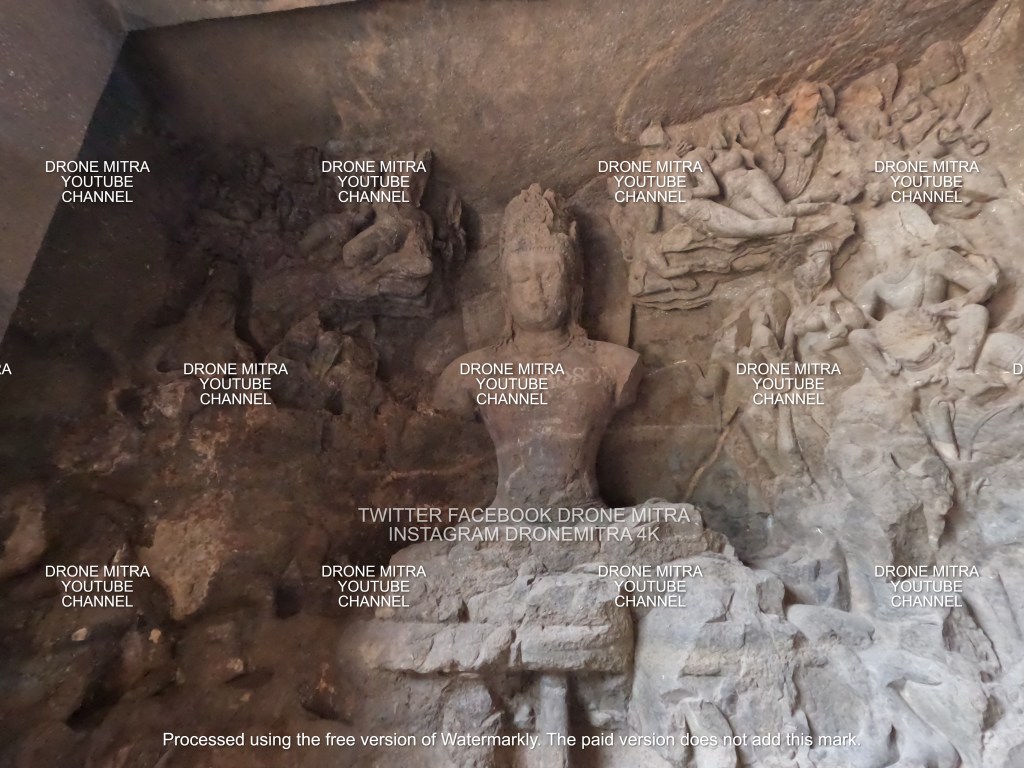
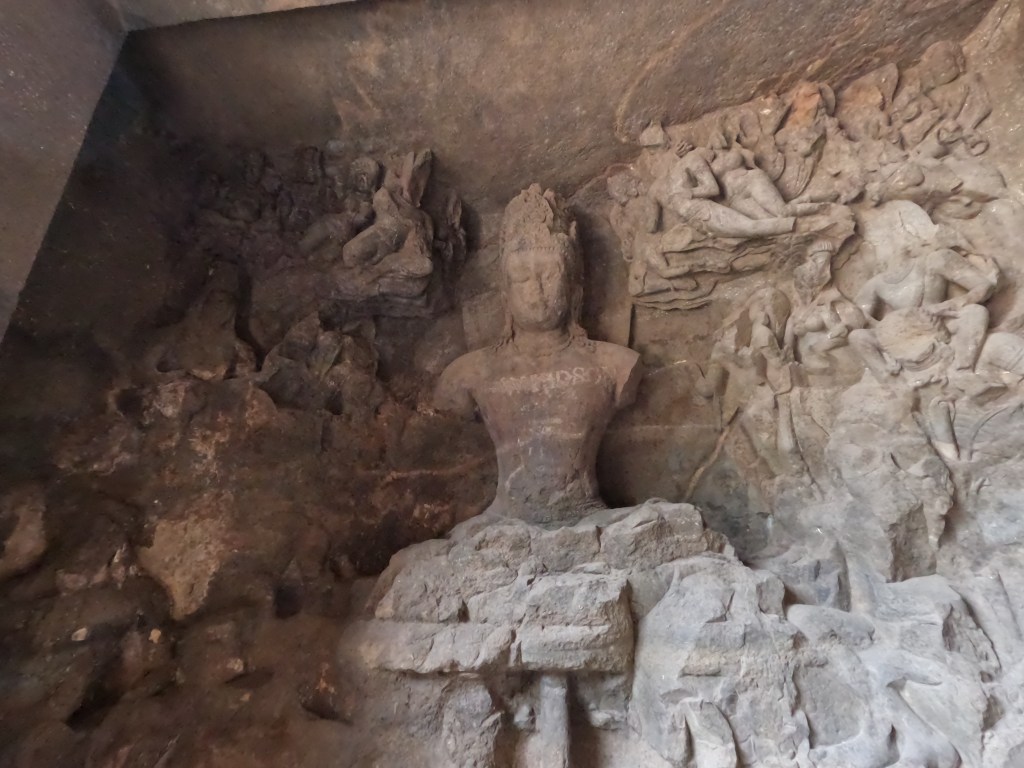
As one enters the cave from the main entrance to the North, immediately to the left and right are sculptured panels representing Shiva as a Lord of Yogis (Shiva Yogeshwara) and the Lord of Dancers (Nataraja). In the former (A) which is to the visitors left, Shiva is shown sitting on a lotus, the stalk of which seems to spring from the primeval waters, where it is held by two Nagas, the genii of the deep. As Yogeshwara, he is the supreme master of all yogic disciplines, as well as the teacher of all the arts that give expression to an understanding and realisation of the ultimate reality. The figure is badly damaged, but the powerful swelling ches and the silent absorbed face, though broken, express great spiritual strength and calm. Flying above are Gods and Godesses with splendid ethereal bodies. In the upper corner to our left can be seen Brahma and Indra seated on their vehicles, the swan and the elephant. Vishnu, who rides on Garuda, is to the right at the level of Shiva’s Chest but the faces of both rider and vehicle are damaged.
NATRAJ SHIVA
KING OF DANCERS
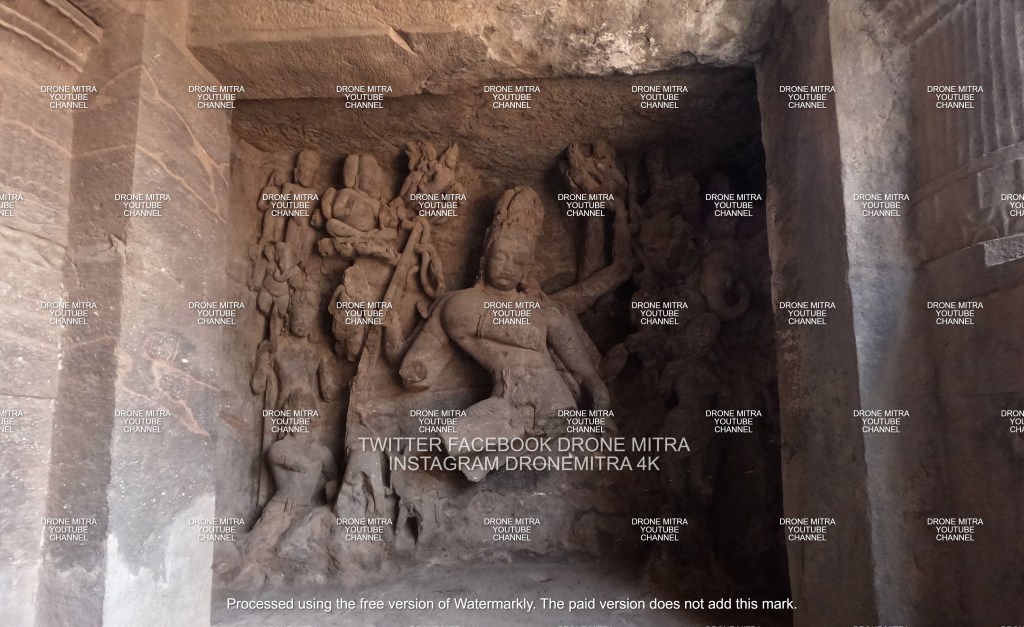
Here too the lower portion of the sculpture is almost completely missing. The Natraj panel is raised on a platform measuring its width 3.28 meters, height 3.40 meters and depth 3.97 meters. The central Shiva figure admeasures approximately 3.24 meters. Shiva is shown with eight hands. The first right arm now broken below the elbow, stretches across his chest in a characteristic pose of all the Lalita dance. Another of his right hands holds a battle axe, from which a snake surges forward, to the rest on Shiva’s shoulders. The face, with the elaborate jatamukuta, is calm and indrawn, as though unconscious of the frenzy of the whirling arms. Note the hair falling over the left shoulder, indicating a pronounced movement to the right which is emphasized by the shoulders of the arm stretched across the chest. The folds of the cloth placed on the right serve only to emphasize the smooth modelling of the limbs. Among the figures to the right is Parvati, and above here is Vishnu, riding on Garuda, both figures being damaged. Indra can also be seen his vehicle, the elephant Airavata. At the bottom to the left is a seated drummer, and above him stands the war god Kumara Kartikeya, the son of Shiva, while above him is a very well preserved image of another son of Shiva, the Elephant-headed Ganesha. On the top are two scantily dressed and amaciated ascetics, and next to them is Brahma, who is usually shown riding a swan but is here shown on a seat that is borne by a row of flying swans. Hovering over the great matted locks of Shiva are the usual long-limbed angels. There are in all 108 postures of Tandava dance. Parvati was also participating in Tandava dance and she was equally a good performer as Shiva. So Shiva by playing hat trick, has raised one of the leg and touched it to his head. The posture is known as Urdharva Tandava posture, but Parvati appears to show hesitance to perform this posture, due to delicacy of womanhood. This is also shown at Ellora in cave no. 16 on the main temple’s plinth level. She appears to be surrendering and admitting here defeat and turns her face. Shiva was honored with title of “Natraj”.
MAHESH MURTY
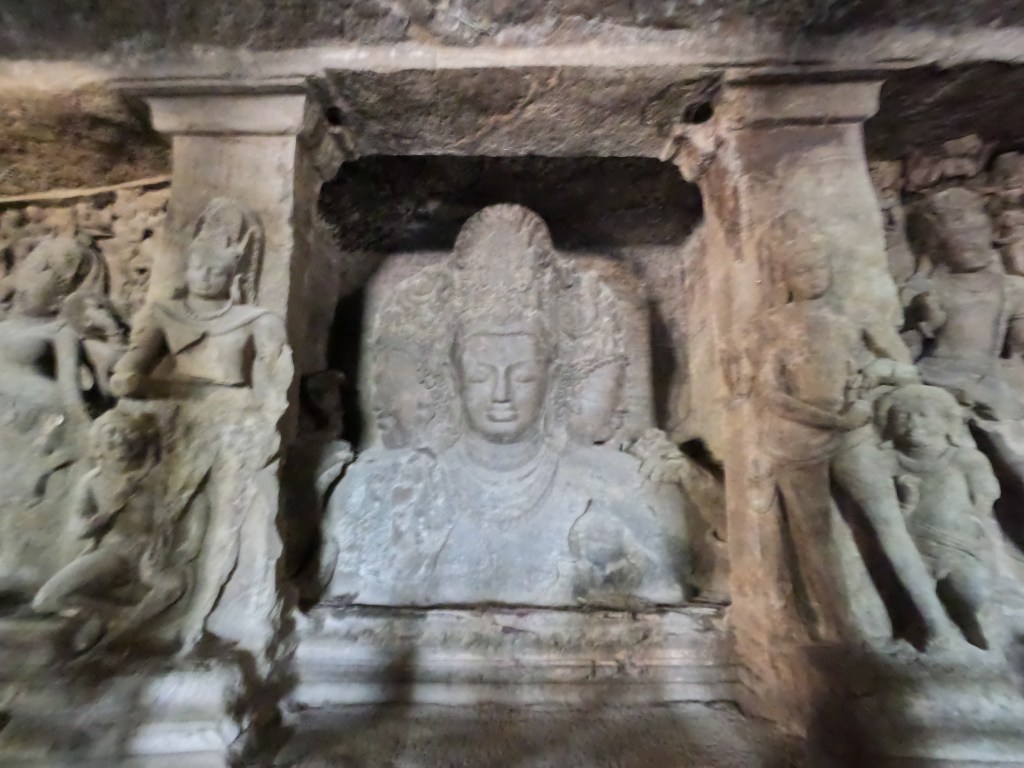
The calm central face of Shiva represent Tatpurusha or Mahadeva.
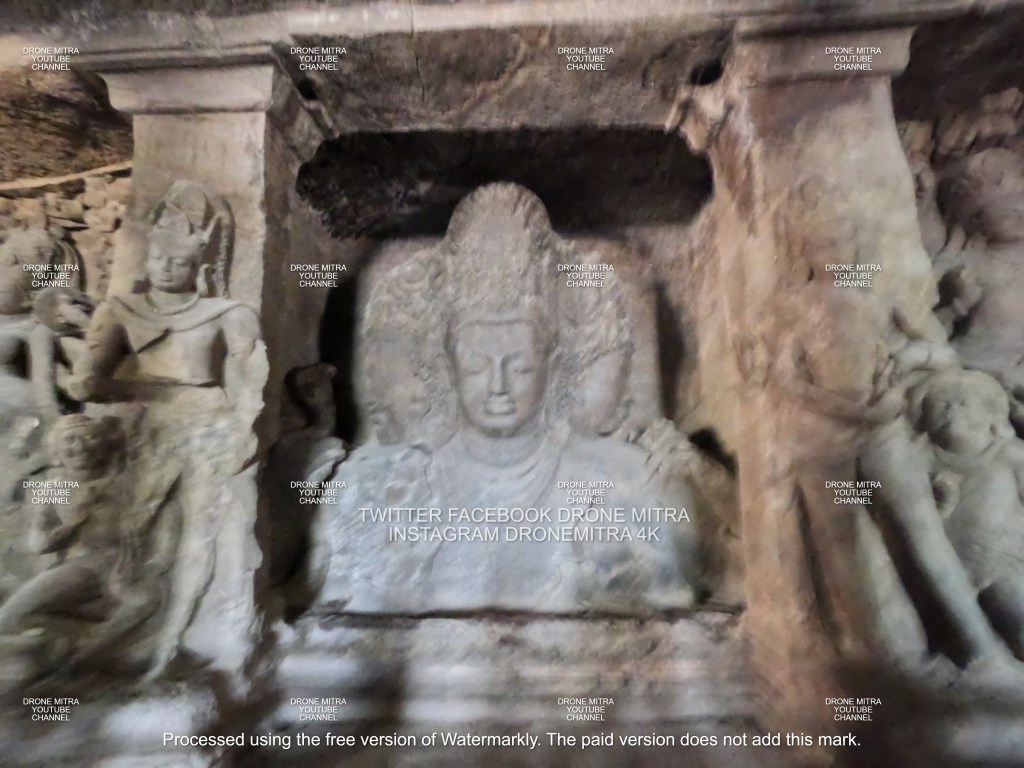
It takes a little while before the eye becomes accustomed to the gloom as we enter the cave properly. Immediately in front, the colossal image of Maheshmurti, the Great Lord, begins to take form in the half darkness, and one is irrestibly drawn to it. The recess having a depth of 3.2 meters and width 6.55 meters. The height of the bust is 5.43 meters above the base. The total height of the figure is 8.3 meters. The image is set in a deep recess flanked by pilasters, on which are figures of dwarapalas, considerably damaged and accompanied by dwarf attendants. It is 18 feet high and represents the crowning achievement of Indian sculpture, not to be ranked second to anything found in the country. The image represents the supreme Shiva, fully manifest. The calm central face of Shiva represent Tatpurusha or Mahadeva with the full sensous lip rests on a chest of mighty proportions, which is adorned by rows of necklaces. The high mountain-like locks of hair piled on top of the head are encircled by an elaborate three pointed tiara, which has a crest jewel in the shape of Kirtimukha (Lion face). One of the hands in front holds a citron, while the other is damaged. The face of destruction, that of Aghora or Bhairava, is to our left, and significantly, is always in shadow, for it is Shiva’s manifestation as the destroyer who ends both death and time. The bulging forehead, hooked nose, cruel mouth and twirling moustache hold terror; and symbols of death, a skull and serpants, adorn his hair, while he holds yet another serpant in his hand. The third face represents the God in his aspect as Vamdeva or Uma, the beautiful god, who is the feminine aspect of creation. The face itself is female in its blossoming beauty, full of solitude and a sensous enchantment. The hand holds a lotus, while the hair is decorated with festoons of pearls and fresh flowers and leaves. The fourth face which is not visible is said to represent Sadyajata or Nandin. On either side of Maheshmurti is a panel one representating Shiva bearing the Ganga (Gangadhar Shiva), and the other Shiva Ardhanarishwara, the Lord who is both male and female.
ARDHANARISHWAR SHIVA
The fusion of the male and female bodies symbolizes the Divine Unity, in which all opposites are resolved.
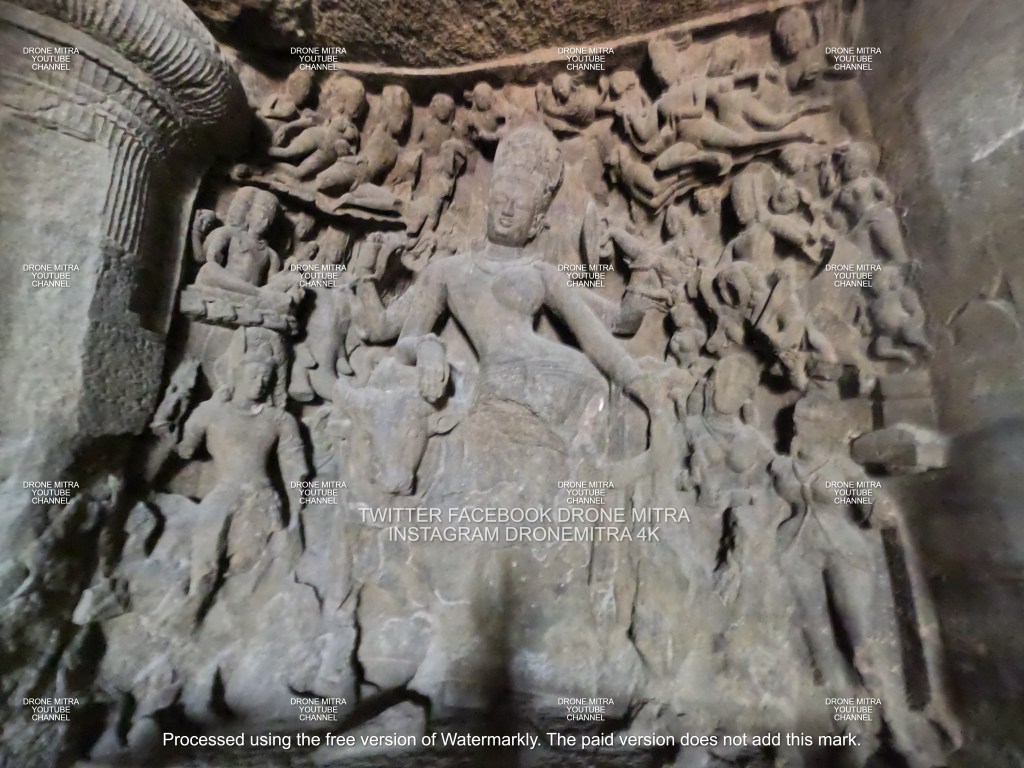
In the later panel of the Maheshmurti, is comparatively well preserved, only the lower portions being somewhat damaged. Shiva, one half of whose body is female, leans against the bull Nandi, the upper hands holding a snake and a mirror. The fusion of the male and female bodies symbolizes the Divine Unity, in which all opposites are resolved. The swelling breast and rounded curve of hip of the feminine body are to the right and the masculine chest and straight slim hips are to the left. The face itself is androgynous in an enigmatic way, being both male and female. Brahma and Vishnu are at their usual places, the former being accompanied by Indra on his elephant. Below them is the war god Kumara, with elaborately dressed hair. In front of Vishnu is Varuna, god of the waters, riding on a makara, and below are two mutilated but superb figures of women, one of whom holds a chauri across her shoulders. Numerous other figures crowd the compartment so that it appears to be the most elaborate one in the cave temple.
GANGADHARA-SHIVA
The moment when Shiva receives the goddess Ganga in his head.
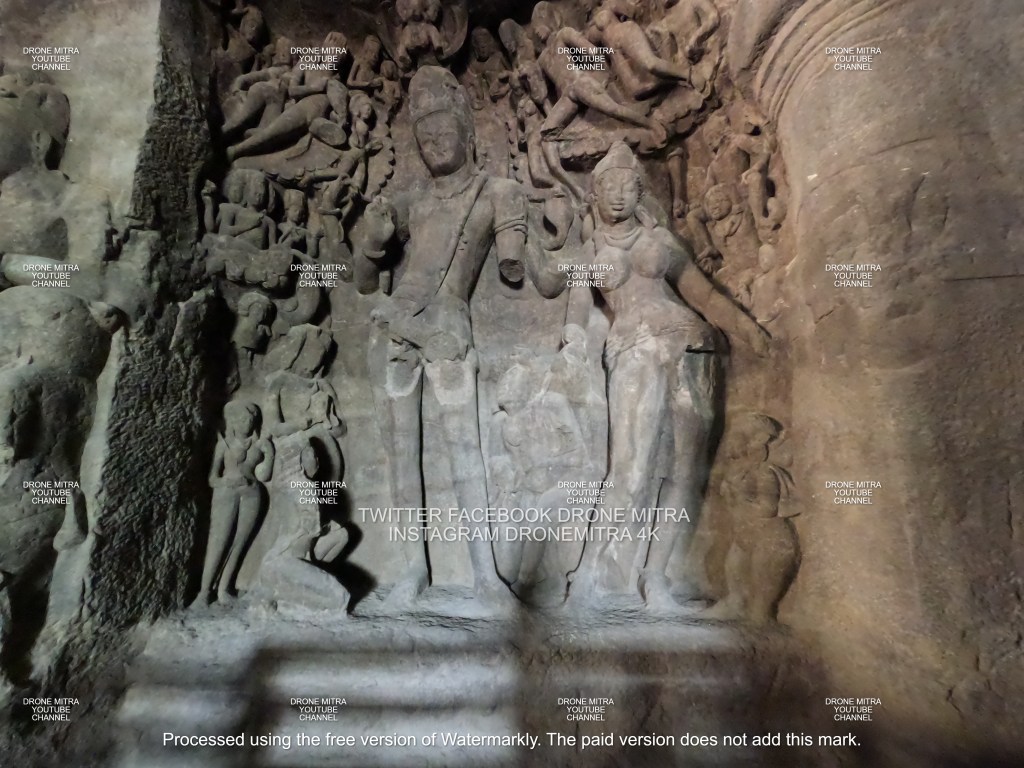
The panel to the right of the spectator is well preserved, and of excellent workmanship. Main figures of this panel represent Shiva and his consort Parvati. The moment when Shiva receives the goddess Ganga in his head it is for this reason that the god in this form is known as Gangadhara or Shiva bearing Ganga. The goddess representing holy river Ganga. According to legend, goddess Ganga was produced from the sweat of Vishnu feet which Brahma collected in his Kamandal (water container) and later released it to fall on earth. To avoid disaster from the impact of its fall, Shiva received her on his matted hair and subsequently released it on earth. Ganga is considered very holy and a bath in its water absolves the bather of sins and opens doors of heaven for him. Ganga water is considered very sacred by Hindus. Also Ganga water remains so good and pure permanently. It does not deteriorate on keeping for any period of time. Bhagiratha, a legendary king, learned that his ancestors, who had been reduced to ashes by the wrath of the great ascetic Kapila, could only attain to heaven if their remains were sanctified by the water of Ganga. The river at that time flowed only in heaven, but agreed to come down to earth as a result of much prayer if someone could be found to break the force of her descent. Bhagiratha next invoked Shiva, who pleased with his austerities, agreed to take the river on His head as she fell from heaven. That He did, the great river being lost in the matted locks for thousands of years before being finally allowed to flow out in a gentle trickle, and Bhagiratha’s ancestors were saved. In the panel we see Shiva at the very moment of the impact of the great river, who is shown as a three-headed goddess just above his hairlocks. Shiva’s body suggests in its gentle swaying the flow of the river. He touches the lovely Parvati at his side, communicating to her the movements of the water. Parvati’s face is turned slightly away, and she smiles gently; it is a common poetic conceit that she was jealous and angry at her Lord for giving another woman shelter. The figure of Bhagiratha kneels at the bottom to the left. The images of Brahma and Vishnu can be seen in their usual places to the left and right. Next to Brahma is Indra, Garuda, Vishnu’s vehicle, is well preserved. Above are the smooth-limbed devas gathering to witness the scene. The heavenly couple immediately above Parvati is of special beauty, and their long limbs float effortlessly on the mesh of clouds, while below are the Ganas or dwarfs that attend Shiva.
SHIVA SHRINE
SHIVALAY – SHIVA MANDIR
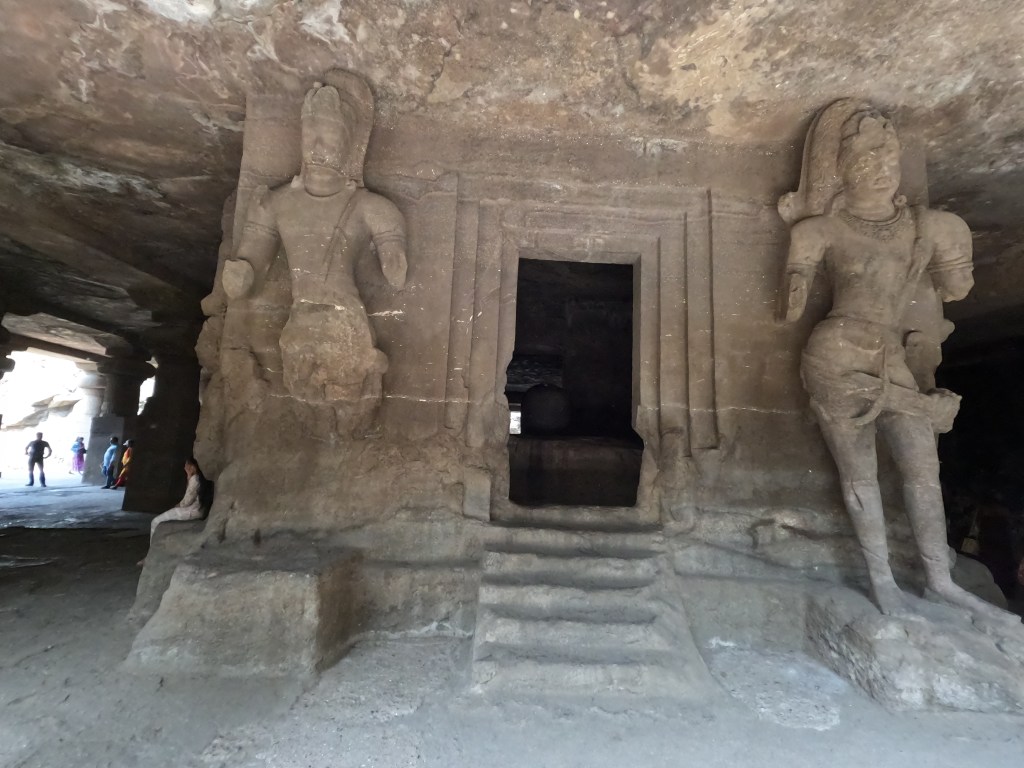
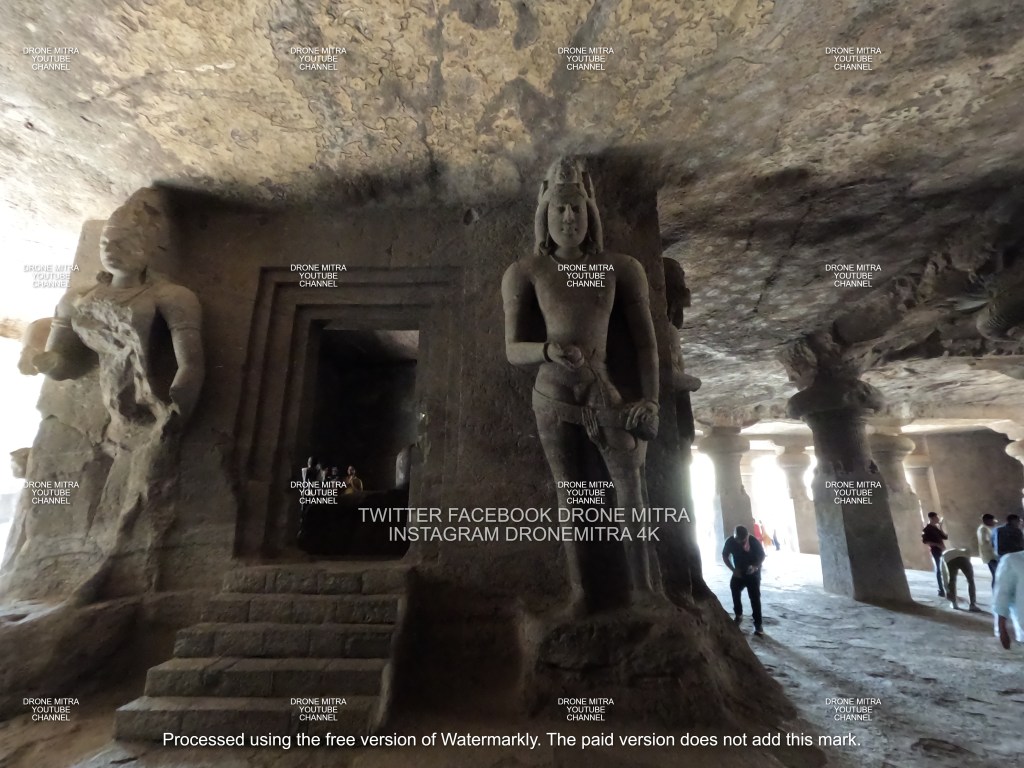
The Shiva shrine is to the visitor’s left as he walks back from the Maheshmurti towards the entrance. It is a small cubical cell facing East with four doors, on either side of which are dwarapalas or door keepers of colossal size. They are very fine works of sculpture and are particularly effective, their powerful bodies pulsating with life contrasting with the dead plain walls of the shrine. They wear ornaments marked by restraint and East wall, facing the aisle, the lower half of which is broken. The exceedingly powerful chest, the silent absorbed eyes and the balanced posture, all speak of immense power, which is however controlled by an inner discipline. The Linga within the sanctum, silhouetted against the light, is very effective. The lower portion of the Linga is supposed to be Brahma, middle one being Vishnu and upper one is Shiva. It is worshipped at religious fairs even to the present day. On Mahashivratri day a big fair is held every year in February-March. Local folk used to worhip this Linga.
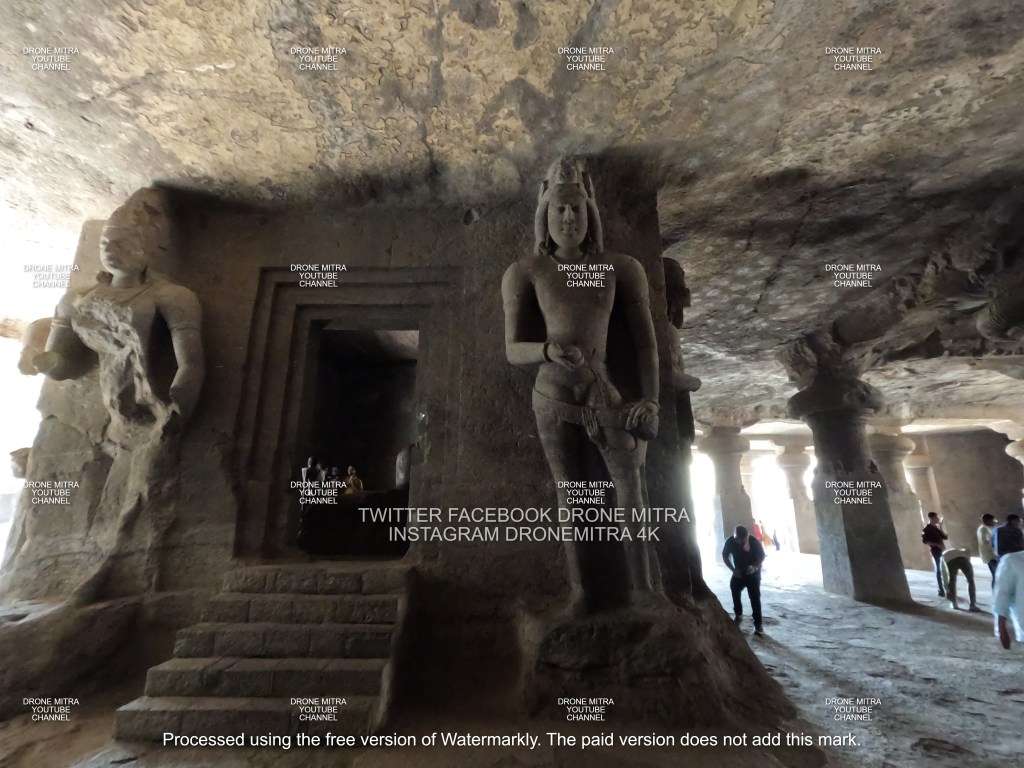
ANDHAKASURA VADH
SHIVA DEPICTED IN HIS FIERCE ASPECT
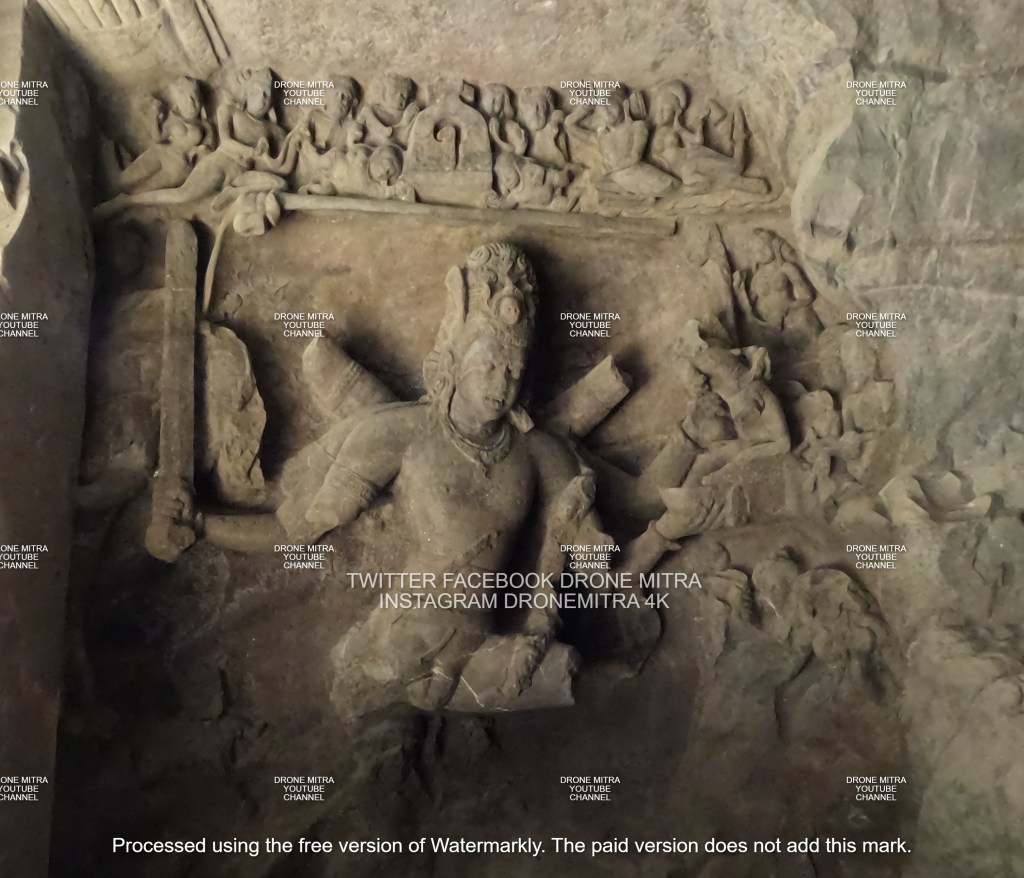
The western porch, behind the Shiva shrine, has sculptured panels showing Shiva as the Destroyer of the Demon Andhaka and another fine panel showing His marraige to Parvati. In the former, Shiva is depicted in His fierce aspect. His body surging forth from the rock as He impales the mutilated figure of the monster, below whom he holds a cup in order to catch the drops of blood that fell to the ground another monster was born to continue the fight against the God. The top left and probably right hands hold the skin of an elephant, whose head is to our left. This is Nila, a demon friend of Andhaka who has assumed animal form to attack Shiva but had been killed and flayed by one of Shiva’s attendants who presented the skin to his master. The teeth of Shiva are bared, his hair is adorned with a skull and the bulging eyes are full of rage. Above are Gods and Goddesses flying through the air and doing homage to what seems to be a votive shrine. The lower part of the image is sadly damaged.
KALYANSUNDAR MURTI
SHIVA PARVATI DAY OF MARRAIGE
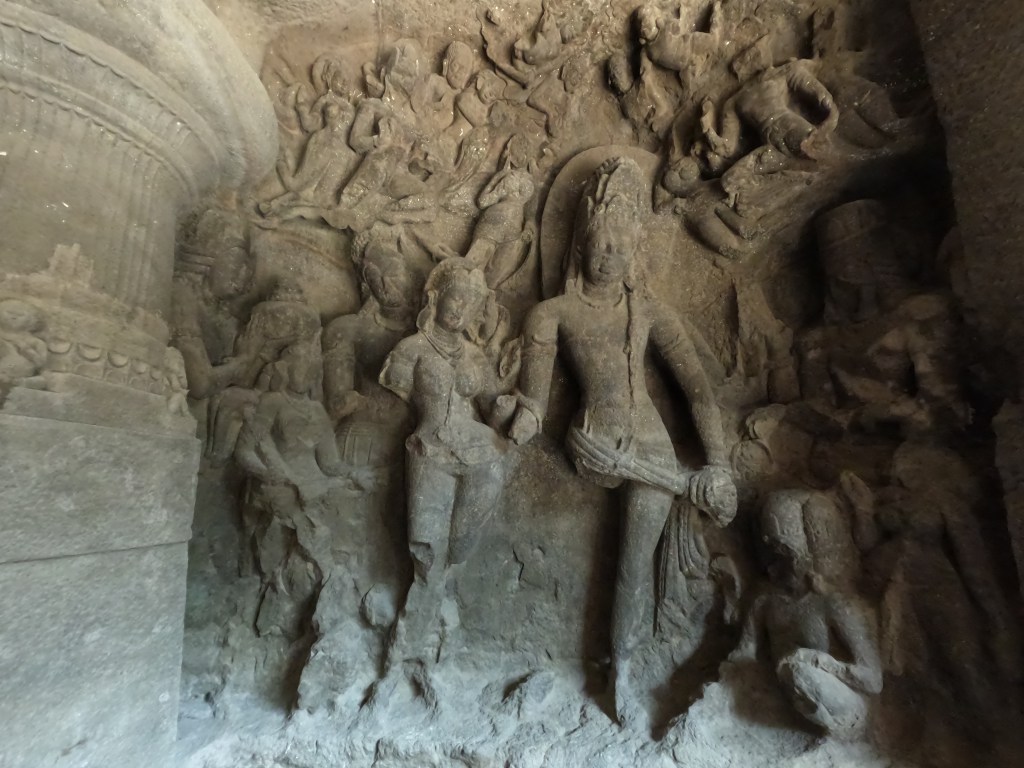
This panel is full of lyrical charm and a gentle poetic quality. The handsome benevolent face of the God is full of serenity. His one hand rests on a thick scarf tied across the hips while other supports Parvati. She is to Shiva’s right, indicating that the actual marriage has not yet taken place, for even in the present days the bride is to the right before marriage but as wife stands always to her husband’s left. Her eyes are downcast, a shy figure, being pushed towards here husband by her father who is giving her away in marriage. Brahma, who squats at the bottom to our right, is officiating as the priest at the ceremony. Behind him is Vishnu, wearing a tall cap. To the extreme left the Moon God, identified by a partially visible crescent behind him, carries an anuspicious vase, while below him is a much mutilated Shauri bearer. Flying angels hover in the sky on clouds to watch the ceremony. Though the panel is greatly damaged, the figure of Parvati is carefully executed and of fine proportions.
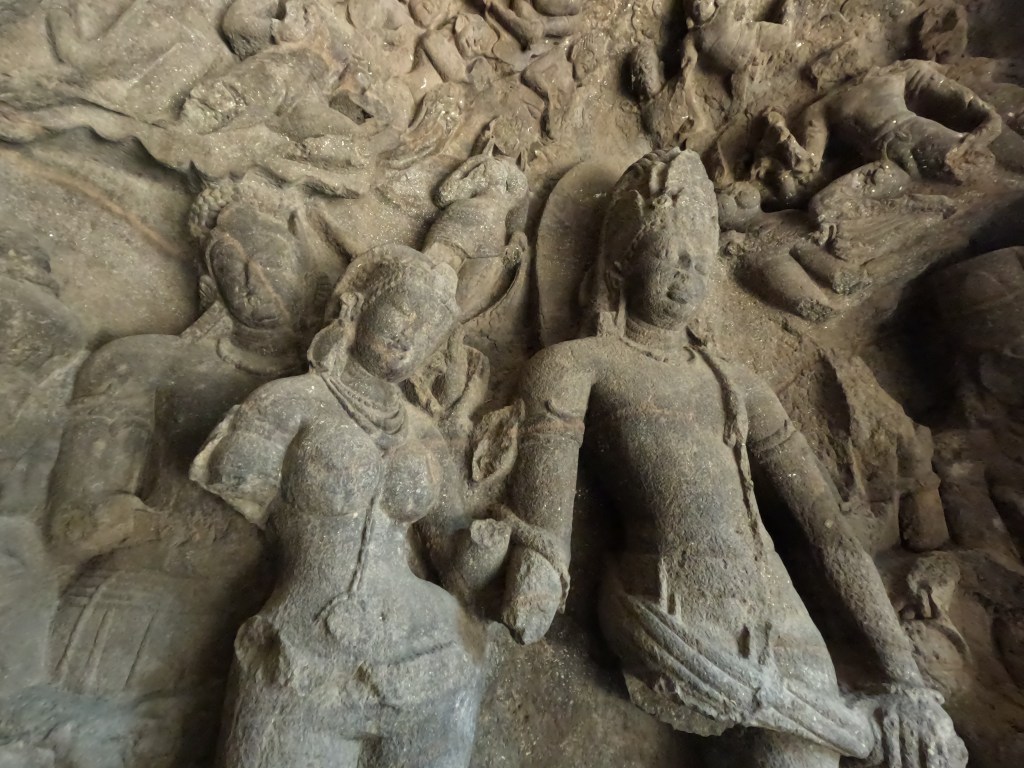
WEST COURT
Entrance of the main Cave (West Court)
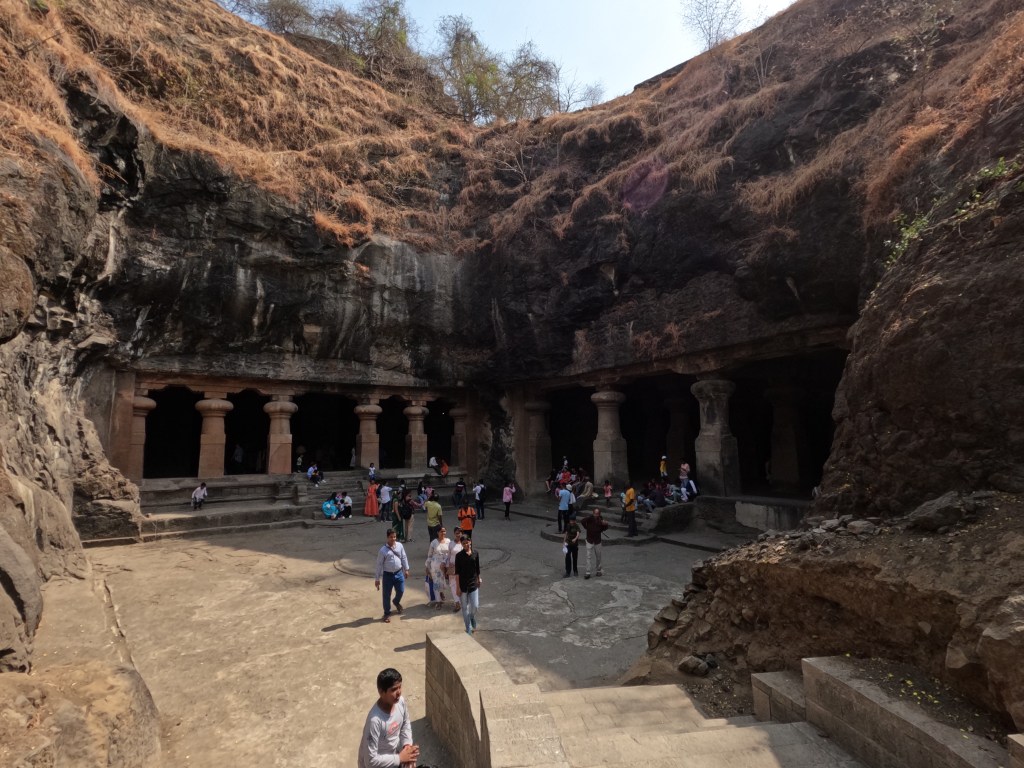
We next descend to the Western Court by a flight of stairs. To the spectator’s left is a large water cistern, and to its side a small Shiva shrine with a portico. On the North side is the figure of Shiva seated on a lotus resembling the panel of Shiva as Yogi at the entrance to the main cave proper, but inferior workmanship. On either side of the shrine door itself are dwarapalas with demons at their feet and flying figures above. To our left, above the water cistern, is a panel showing Shiva performing the Tandava Dance.
RAVANUGRAHA MURTI
RAVANA SHAKING KAILASH
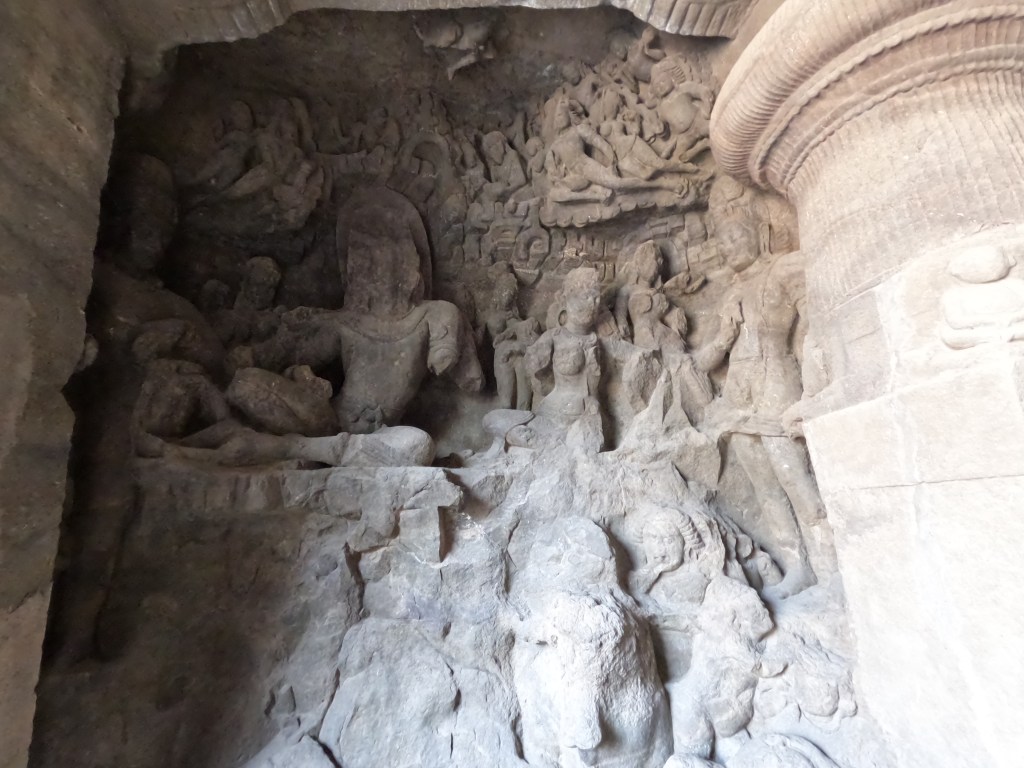
Retracing our steps we walk through the main cave to the Eastern Court. The panel to the left depicts the Hindu legend in which the powerful demon Ravana, drunk with pride, tried to uproot Kailasha, the abode of Shiva. He managed to shake and lift the mountain, terrifying its inhabitants, whereupon Shiva pressed the toe of His left foot on the ground, as a result of which the mountain settled back to its original position, imprisoning Ravana below. It was only after many prayers and entreaties that Shiva, who forgives as easily as He is angered, released him. In the sculpture we see projecting cubes that represent the mountain, with the greatly mutilated figure of Ravana below, while above is the tall graceful figure of Shiva, with the third eye clearly visible on his forehead. Many of his hands are broken. He steadies Parvati with one hand and with two others holds the hair of his attendants in order to keep them from falling. Ganesha is to our right and behind him is a large figure, one of his hands resting on the head of a dwarf. Opposite is another similar image. Various attendants can be seen, including the emaciated Bhringi near Shiva’s foot.
UMA MAHESHA MURTI
SHIVA – PARVATI PLAYING A GAME OF DICE
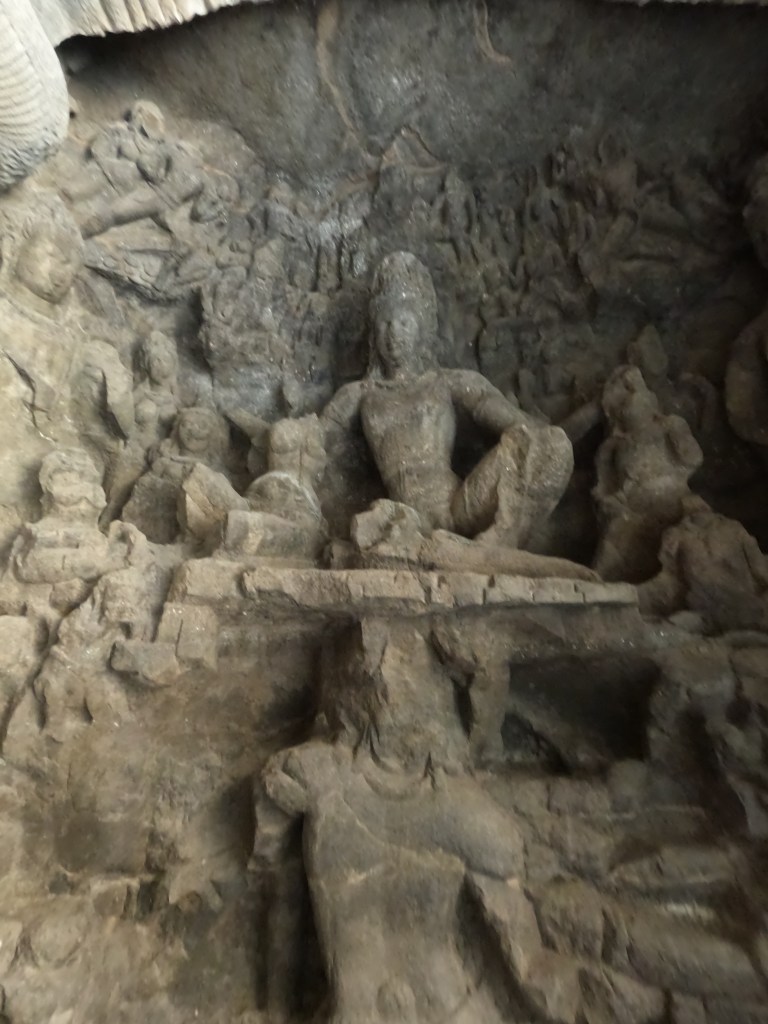
Facing this panel is a scene of domestic bliss on mountain Kailasha. Shiva His face badly mutilated, is seated in an easy graceful posture, while Parvati, in a petulant mood, has turned here face away from Him in feigned anger. Between the couple is a female figure, with a child on her hip, carrying a chauri or fly switch. The projecting cubes suggest the mountain, while the arches in it are the caves. The lower portion is badly mutilated, except for Nandi, the head of a gana and three frolicking ganas in the right corner. At the sides are two large attendants similar to those in the panel opposite. Above are the usual long-legged celestial figures.
EAST COURT
SPACIOUS COURT
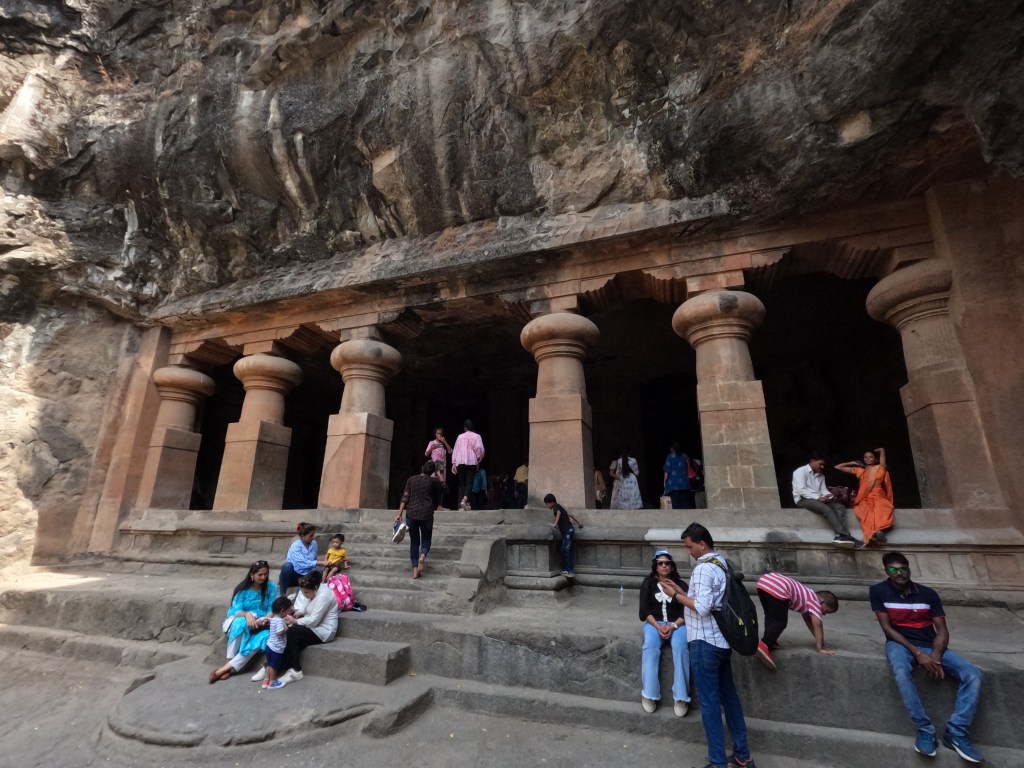
We now cross over to the spacious court in front, containing a circular pedestal, in all probability the original seat of Nandi, the vehicle of Shiva. Facing the courtyard is Shiva shrine tha is reached by a flight of steps formerly flanked by two mythical lions. These are now placed at the doorwar of the Sanctrum.
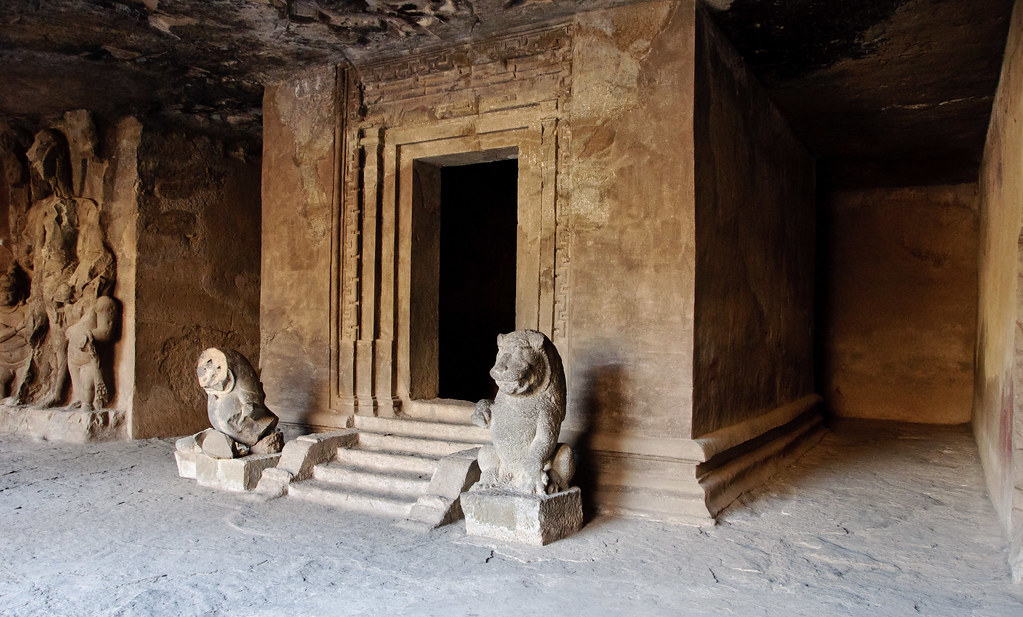
On either side of the path circumambulating the sanctum as a dwarapala. The dwarapala to our left is badly damaged, bu the ganga below whose hands are across the chest in a characteristic wrestling pose is well preserved. The adjoining cell at one end of the porch is empty.
On the right sides is a four handed Dwarapala who lends on a dwarf bearing a cushion on his head.
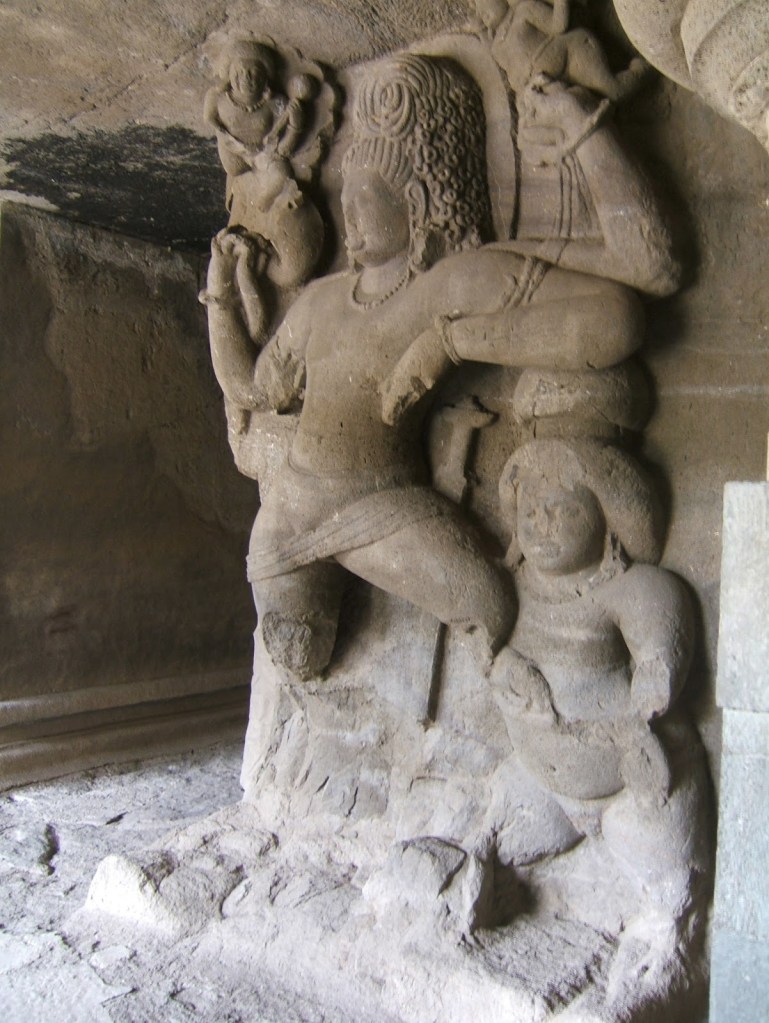
The dwarapala holds a serpent in one hand and his sword is visible behind. The hair is tied in a high jatamukuta and flows down in numerous curls. The cell adjoining the sculpture has numerous images.
The wall opposite the entrance contains representations of eight standing matrikas or Mother Goddesses; all are badly damaged. They are flanked by Ganesha and Kartikeya, who are also shown seperately on the walls to left and right. Here they are themselves great Gods, surrounded by other dieties of the Hindu pantheon including Brahma and Vishnu. Traces of the painting that once adorned the entire cave temple can be seen on the ceiling.
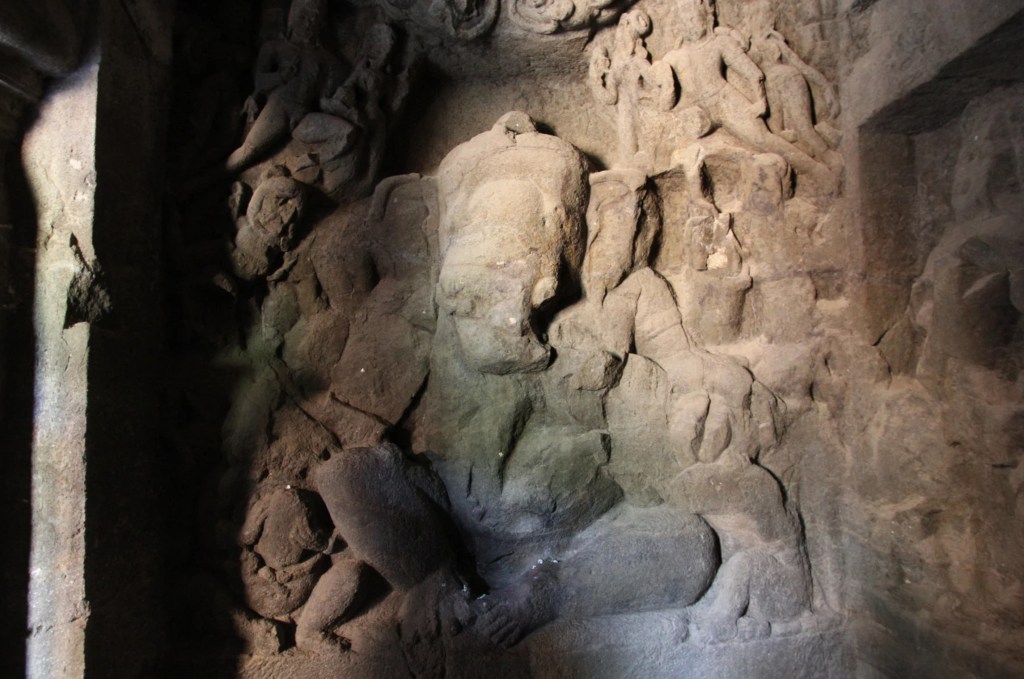
Besides the main cave there are other smaller cave shrines on the island. They are however not of very great interest and except to the visitor who is especially interested in Indian archaelogy or with a surplus of time, hardly worth the visit.

VISITORS INFORMATION
The most convenient season for visiting the caves is winter months from November to March. Summer months as well for someone prepared to face the coastal humid climate, but during the rainy season from June to September everything almost comes to a standstill because of the heavy rainfall and the launch services are suspended during this time.
Monument is open on all days except Monday from 9:00 A.M. to 5:00 P.M.
Launches are available for visiting the island from Gateway of India from 9:00 A.M. The last boat leaves from Gateway of India at 4:00 P.M. While the last boat from Elephanta at 5:30 P.M. ( Tourists can return by any boat).
There are local restaurants providing good quality of food and services near the steps.
MTDC Chalukya Restaurant (Veg. and Non. Veg.) with Bar and Room facilities.
CAB BOOKING FOR MUMBAI 8 HOURS OR 12 HOURS
MUMBAI LOCAL TAXI 8 HOURS AND 12 HOURS OR FOR THE ENTIRE DAY
We are taxi company serving all across Western INDIA with our cars stationed at Mumbai, Thane, Navi Mumbai, Pune, Nashik, Ahmedabad, Surat, Vapi, Daman Silvassa, Valsad, Surat Ahmedabad and Saurashtra. We are a professional taxi company operating a quality fleet of dedicated taxi vehicles such as the legendary SUVs such as Toyota Innova, Innova Crysta Mahindra Marazzo & Suzuki Ertiga as well as Sedans such as the Suzuki Dezire, Toyota Etios, Hyundai Accent, Honda Amaze non-stop, around the clock.
Tempo Traveller with a carrying capacity of more than 17 and other Mini Buses of upto 56 Seaters, Luxury Buses are also managed by us and are available to book in advance.
TO BOOK Call or send a Whatsapp message to +91 7506553985


 Drone Mitra